For athletes
Train against the people you are chasing.
Online programming written by the coaches who run Canada's national flag football squads, using the same reference set those athletes are measured against.
Your first week is your baseline. Film a sprint, log your sets, and the numbers start there.
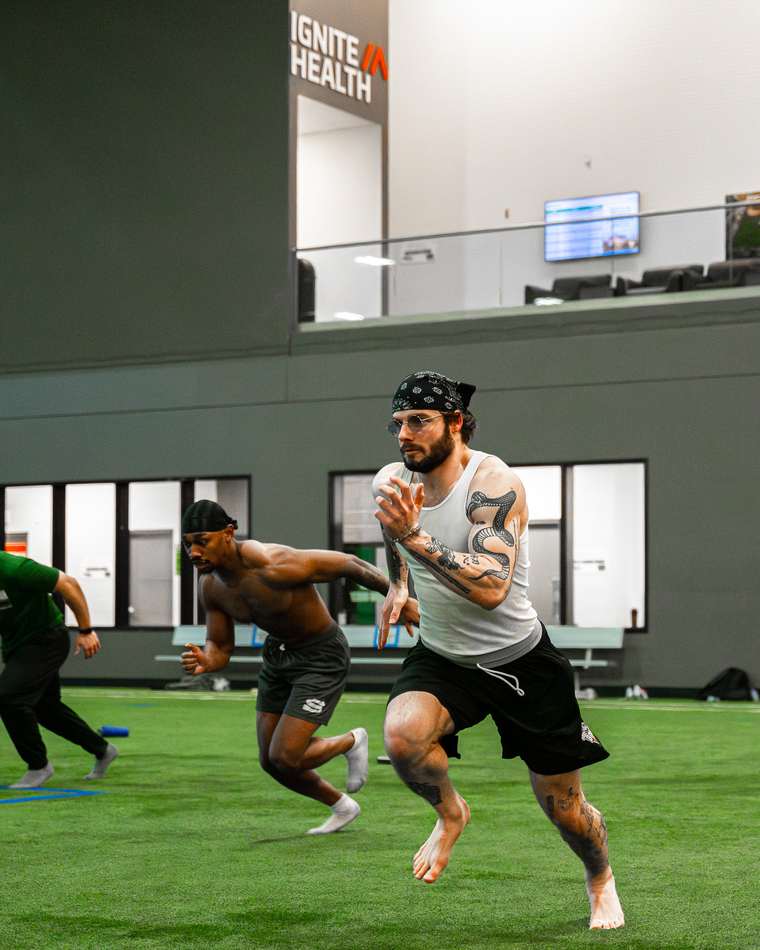 Ignite Athletics, indoor field
Why buy from us
We coach the national team. You get the same reference set.
Ignite runs performance for Canada's men's and women's flag football squads through the LA 2028 cycle. Those athletes test on the same plates, into the same database, against the same protocols as everyone else on this platform. So when we tell you your reactive strength is short, we are not quoting a textbook number from another sport. We are quoting the people playing at the level you are trying to reach.

Top-end speed sits inside the university band and short of the national squad. The distance is about half a metre per second, which is a mechanics and top-end exposure problem before it is a strength problem.
Drag the slider to place your own number. Reference bands in this comp are illustrative. In the platform they are drawn from tested athletes and reported as aggregates only, never as any individual athlete's results.
One system, both directions
Training becomes measurement. Measurement becomes training.
Everything an athlete does lands on one profile, whether it was measured on a force plate in Saskatoon or filmed on a phone in a garage in Halifax. The model reads that profile, the next block is written against what it finds, and the cycle runs again.
In the building
- Force plates and timing gates at the Athlete Lab
- GPS and external load on the field
- Hop battery and mobility screen on film
Anywhere else
- Bar speed from a phone propped against a plate
- Joint angles from a filmed sprint or jump
- Every set logged, every exercise with its video
How it runs
What the first six weeks actually look like.
Week 0
You test. In Saskatoon that is force plates and timing gates. Remote, it is a video protocol on your phone that we check frame by frame before anything is written.
Week 1
Your programming lands in the app with the block marked on every lift. A coach walks you through why the first block looks the way it does.
Weeks 2 to 5
You log sets. A coach reads them weekly and adjusts load, volume or exercise selection before the next week opens.
Week 6
First checkpoint. Not a full retest, but enough to know whether the block is moving what it was built to move.
The app
Log a set. Watch it land on the coach's screen.
This is the real interface, not a picture of one. Tap a lift, put in a load and reps, and log it. The panel on the right is what your coach sees while you are still standing at the rack.
Nothing logged yet. Log a set on the phone and it appears here.
The same symbol system runs on the phone at the same size, so an athlete looking at their session sees exactly what the coach saw when they built it.
Find out where you actually sit.
Build the program. Your first week sets the baseline, and the coach reads it from there.
Build your program